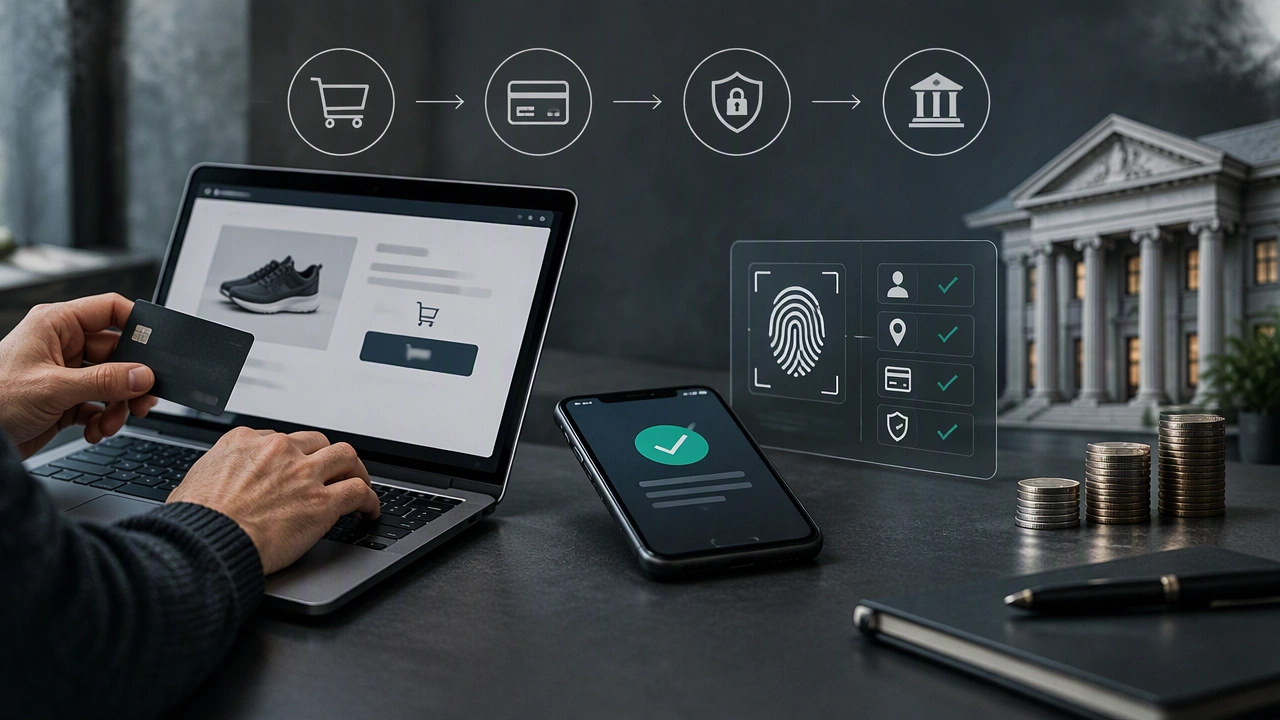
How Online Payments Move: From Checkout Click to Bank Settlement and Fraud Checks
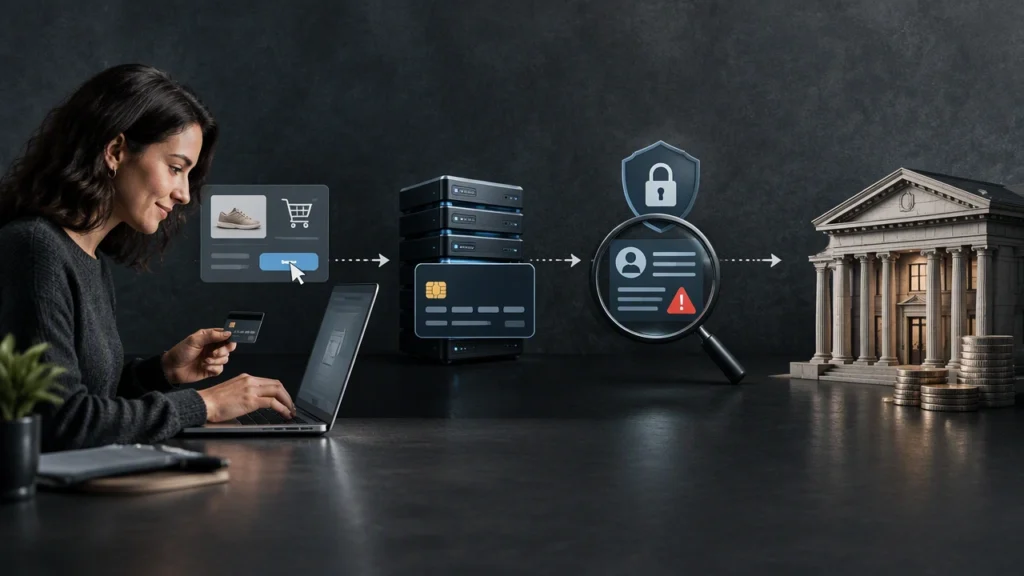
When you click “Pay now,” money does not instantly jump from your account to the merchant. Behind that single click is a choreographed exchange of encrypted messages between web services, financial networks, and risk systems that completes in seconds. Understanding how are online payments processed securely helps explain why a transaction is approved, declined, or held for review, and what keeps your card data safe at each step.
This journey involves several distinct parties that never directly share your full card details with the merchant. Instead, they pass tokens, authorization codes, and settlement files through secure channels. Here is how the flow works, from checkout to final settlement.
1. Checkout: Capturing Payment Information Securely
Everything starts on the merchant’s checkout page or app. When you enter your card number, expiry date, and CVV, that data is not sent as plain text. The checkout form is typically hosted or secured by a payment gateway and protected by TLS encryption, the same technology that shows a padlock in your browser.
Modern checkouts also reduce exposure by never storing raw card data on the merchant’s servers:
- Hosted fields or iframe: The card input boxes are actually served by the gateway, so the merchant sees only a confirmation, not the number itself.
- Client-side encryption: Your browser encrypts the data before it leaves your device, so even if intercepted, it cannot be read.
- Address and verification data: Billing address, ZIP code, and CVV are collected to support later fraud checks without being stored long-term.
Once you confirm the payment, the browser sends this encrypted payload to the payment gateway for the next stage.
2. The Payment Gateway: Encryption, Tokenization, and Routing
The gateway acts as the secure bridge between the merchant and the financial network. Its first job is to protect data at rest and in transit. It decrypts the incoming payload inside a certified, isolated environment and immediately replaces sensitive values with tokens.
Tokenization substitutes your 16-digit card number with a random token that has no value if stolen. The gateway keeps the mapping between token and real number in a hardened vault, while the merchant and later systems work only with the token. This is why you can save a card for future purchases without the store actually storing your card.
The gateway also performs initial validation:
- Checks that the card number format and expiry are valid
- Verifies the merchant’s identity and that the transaction amount matches what was displayed
- Adds metadata such as device fingerprint, IP address, and time stamp for fraud screening
After these checks, the gateway forwards the tokenized transaction to the payment processor.
3. The Payment Processor and Card Networks
The payment processor is the service that connects the gateway to the card networks — Visa, Mastercard, American Express, and others. Think of the processor as a logistics hub and the card network as the highway system that knows how to reach every bank.
The processor receives the transaction, identifies which network to use based on the card’s Bank Identification Number, and formats the message to network standards. It also handles compliance tasks such as ensuring the transaction meets Payment Card Industry Data Security Standard requirements and that 3D Secure authentication, if required, has been completed.
At this point, no money has moved. The processor is simply routing a request for authorization: “Can this customer pay this amount to this merchant?”
4. Authorization: The Issuing Bank Makes the Decision
The card network routes the authorization request to the issuing bank — the bank that issued your card. The issuer has the most complete view of your account and risk profile, so it makes the final approve-or-decline decision within one to two seconds.
The issuer checks several factors instantly:
- Available funds or credit: Is there enough balance or credit limit to cover the amount plus any holds?
- Card status: Is the card active, not reported lost or stolen, and not expired?
- Risk signals: Does the transaction match expected behavior, or does it look unusual compared to past spending?
- Authentication result: If 3D Secure or biometric verification was used, did it pass?
The issuer then returns an authorization code — approved or declined with a reason code — back through the same chain: network to processor to gateway to merchant. If approved, the issuer places a temporary hold on the funds. The merchant can now confirm the order, but the money is not yet in its bank account.
5. Fraud Checks at Every Layer
Fraud screening does not happen in one place. It is layered so that different systems catch different types of risk without slowing the checkout unnecessarily.
Gateway-Level Screening
The gateway runs real-time rules before the transaction even reaches the network. It may flag mismatched billing addresses, disposable email addresses, rapid repeated attempts from the same device, or an IP address far from the shipping address. Many gateways use machine learning models trained on millions of transactions to assign a risk score and can block or challenge high-risk payments with additional verification.
Processor and Network Risk Tools
Processors and card networks operate broader fraud networks. They see transactions across thousands of merchants, so they can detect patterns like card testing, where a stolen card is tried with small amounts at multiple stores, or velocity abuse, where many purchases occur in minutes. Networks also provide services like Address Verification Service and CVV validation, and share fraud signals back to issuers.
Issuer and Behavioral Analytics
The issuing bank applies the most personalized checks. It compares the purchase to your typical location, merchant categories, and spending amounts. An unexpected high-value electronics purchase abroad may trigger a decline or a step-up authentication request, while a regular grocery purchase in your home city passes silently. If fraud is suspected after approval, the issuer may still reverse the hold and notify you.
6. Capture and Settlement: Actually Moving the Money
Authorization only reserves funds. To collect them, the merchant must capture the transaction, usually when the order is fulfilled or shipped. The gateway sends a capture message through the processor and network to the issuer, confirming the final amount. This can be the same as the authorized amount or slightly different if tips, shipping adjustments, or partial shipments apply.
At the end of the business day, the processor batches all captured transactions and initiates settlement. This is a separate file-based process:
- The processor sends a settlement batch to the card network, detailing how much each issuer owes.
- The network facilitates the transfer, debiting issuers and crediting the acquiring bank — the merchant’s bank.
- The acquiring bank then deposits the funds into the merchant’s account, minus interchange fees and processing fees, usually within one to three business days.
Settlement is why refunds take time. Reversing a payment requires a new settlement message to move money back, rather than simply canceling the initial hold.
7. What This Means for Shoppers and Merchants
For shoppers, the key protections are invisible by design. TLS encryption, tokenization, and limited data retention mean your full card number is rarely stored or transmitted beyond the secure vault. Authorization holds and layered fraud checks reduce the chance that a stolen card can be used successfully, while 3D Secure and bank alerts give you a chance to confirm unusual activity.
For merchants, understanding this flow clarifies why using a reputable gateway and processor matters more than building a custom form. It also explains common checkout outcomes: a decline may reflect insufficient funds, not a technical error, and a delayed settlement is normal rather than a sign of lost money.
From checkout encryption to gateway tokenization, processor routing, issuer authorization, and final bank settlement, each step adds a layer of security and accountability. That layered design is what allows online payments to feel instant while still protecting both sides of the transaction.